


Welcome to my story, if you missed part 1, you can catch up here. Some of you may find parts of this post distressing, but I hope it leaves you informed and rest assured although I remain deeply affected by what’s happened, I’m happy and appreciative in my daily life and I am not ruled by it. You’d never know if you met me!
Part 2 continues the story, Amy is about 6 months old, I’m recovering from postnatal depression.
I started to get out more. I took her to a swimming lesson weekly, I went to baby signing once a week. I also went back to work and put her in nursery 3 days a week. I enjoyed my ‘free’ time. When you go to baby groups and mix with other mums and children, you can’t help but compare yourself and your baby to others. Babies that were the same or similar ages in particular, I would be constantly comparing what they could do. They just seemed more aware of the world. When Amy was born, her cousin, my niece was born 2 days later and we couldn’t help but compare the two. I get on well with them and I never had a problem with it. She was the second child of my sister in law so when there were little differences, we (including the family), put it down to her being the second child and learning from her older sibling. That first Christmas, when the girls were 6 months old, they reacted differently to their toys, but it wasn’t that noticeable.
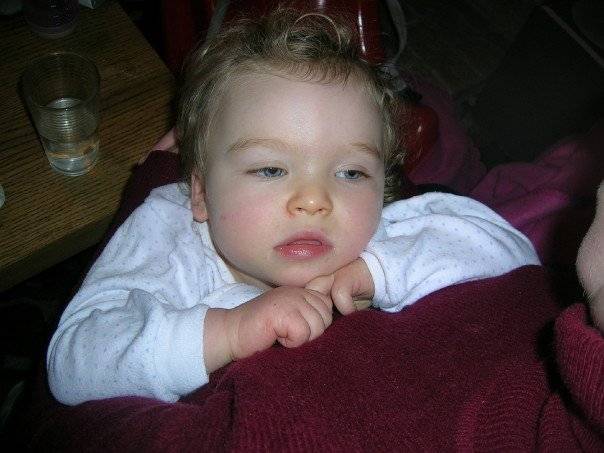

What was noticeable was Amy’s dribble! From about 5 weeks old onwards she would dribble loads, if I didn’t put a dribble bib on her then her clothes were soaked – but babies dribble, right? I was later to find out it was a classic sign of low tone. My in-laws joked about it, as my husband dribbled as a baby and they used to call him a slug, because he pulled himself along commando style leaving a dribble trail in his wake!
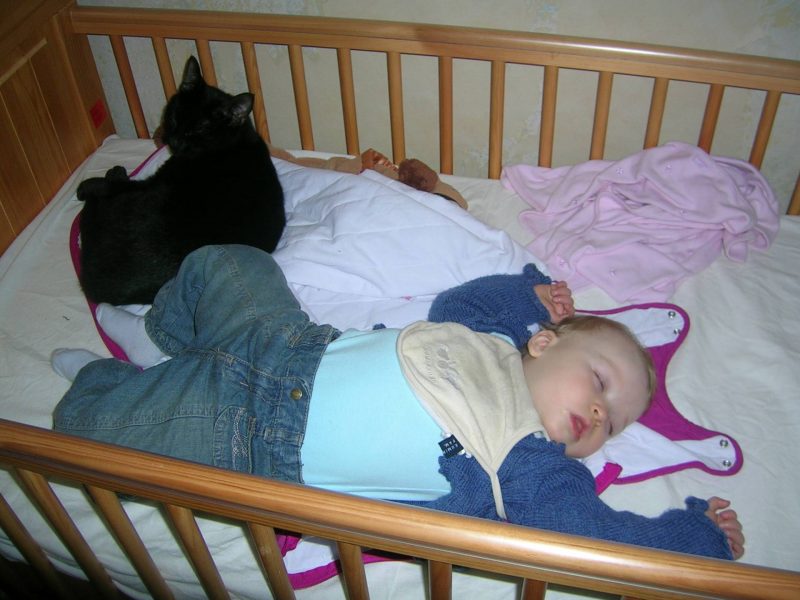

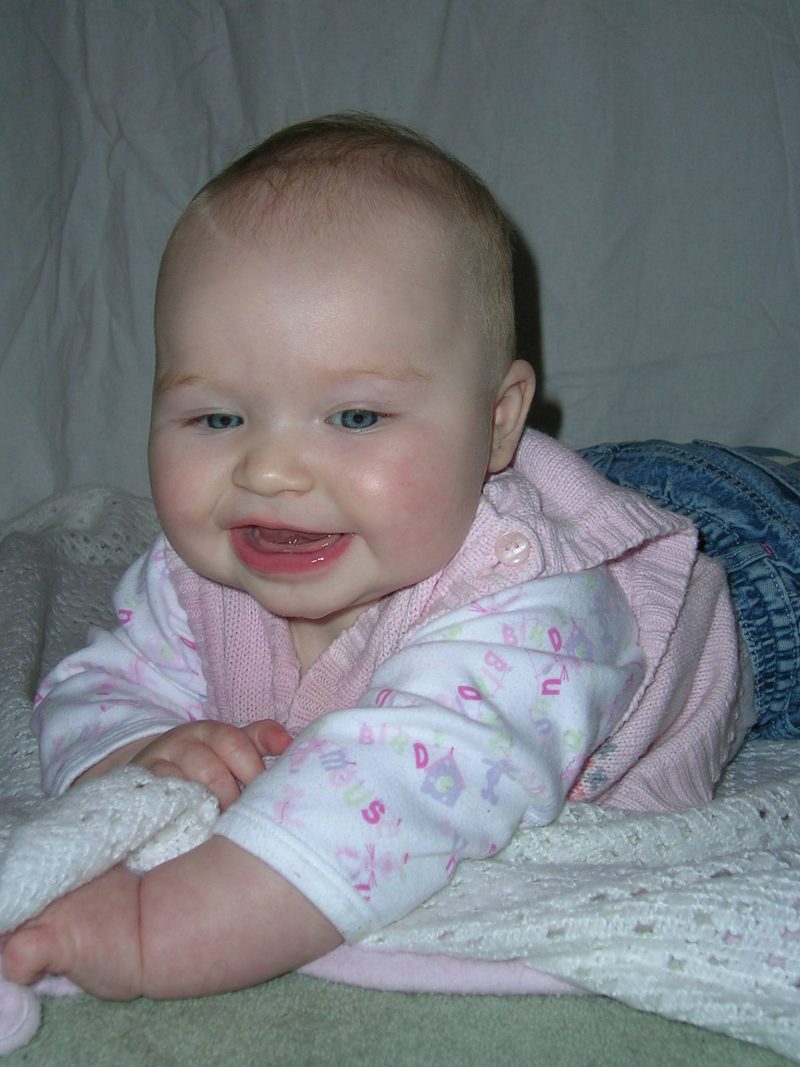
One of the milestones parents look forward to is when your baby can sit up and play. I knew it was around 6 months, I tried to encourage her, prop her up, it just never happened. I think she almost made it for a bit around 7 months old but it was with a hunched over look – I would watch other babies with their ramrod straight backs and wonder why mine didn’t do it. Amazingly, she rolled over at 4 months old from back to front, she hated being on her back and would flip over the minute she could. A couple of times she made it back the other way. I waited for the crawling – this, alas never came.

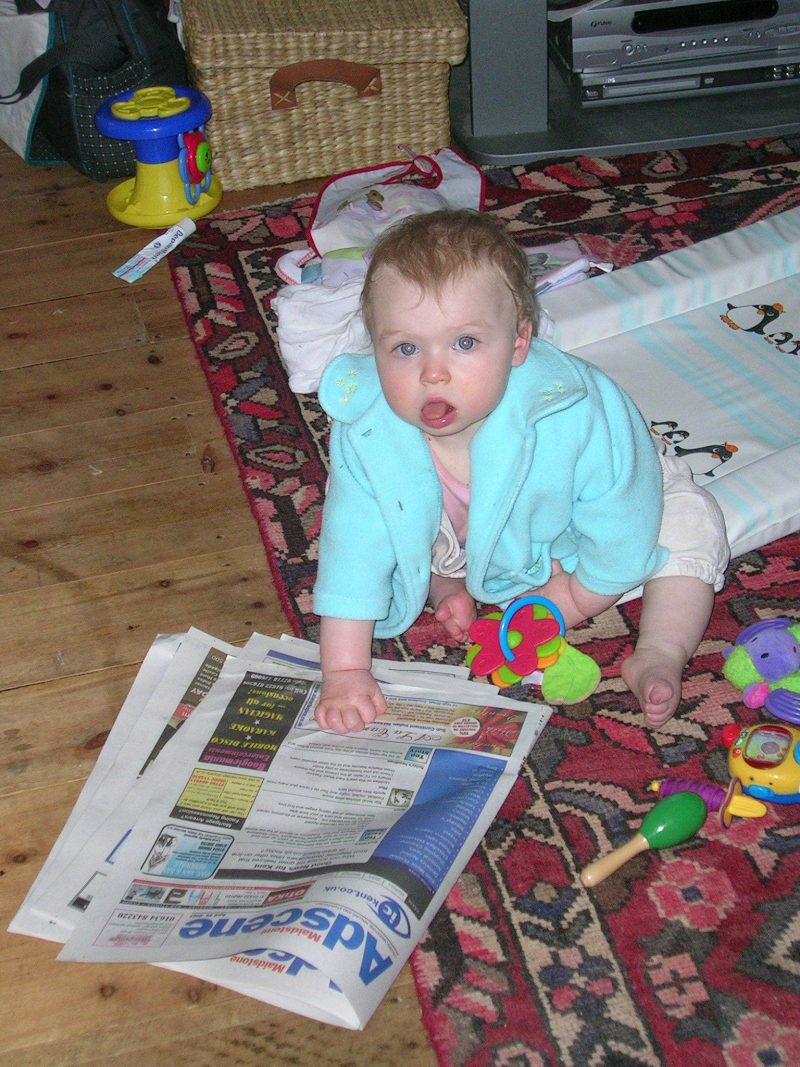
The closest she got to sitting up
Looking back on these photos it was obvious something wasn’t right, but I think to protect myself I shut out the darker thoughts and just hoped it was something that could be changed or worked on. People around us must have been talking about it.
We’d started solids and were making progress – she seemed to like everything and we tried to progress onto finger foods. She would grasp objects if you placed them in her hand, but didn’t seem able to put them to her mouth. I went from purees to lumpier purees (I hadn’t heard of baby led weaning then so I went with the information I knew about).
When she was around 8 or 9 months old I had voiced concerns to friends and family, she wasn’t developing the pincer grip, crawling or grasping like she should, and other babies seemed way ahead. Eventually I went to see the health visitor. I half expected/ hoped she would tell me to stop worrying, they all develop differently, blah blah, but she said Well done for coming, that’s the first step, and referred me to see the GP who specialised in children. Around the same time the nursery took me aside and said they’d noticed a few things weren’t as they should be. Another week to wait for that appointment. I started to worry about the heel prick test (PKU, Guthrie, Newborn Blood Spot, all the same thing), as I’d never heard back from it and assumed all was well. This was confirmed negative. I’d have been outraged if it hadn’t have been, as some of the conditions are preventable. I saw the GP, who took a look at her, asked me some questions and referred me to the specialist children’s centre and health visitor. Another wait – I can’t remember how long, at least another week or two, then we got a home visit from the specialist health visitor. She didn’t have any answers but arranged for the orthoptist to look at her eyes and for an assessment at the children’s centre. Another wait. By now, I’d noticed that not only was she not developing as she should, but that she seemed to be losing skills that she had once developed. She wasn’t able to sit at all, she couldn’t roll as easily from front to back, her grasping was worse, in fact she couldn’t hold anything if I remember rightly. She startled very easily too. She was also getting constipated, she wouldn’t go for a few days, then she would cry as she passed a very hard poo (TMI). I remember this happening at a family day out to the beach. We were all so concerned about her but didn’t know what to do. My mother in law and I thought she’d be ok once she got the right therapies.
I saw a panel of people at the same time at the children’s centre, consisting of a speech therapist, play therapist, orthoptist, physiotherapist and an occupational therapist. There could have been others, that’s all I remember. They tried to get her to do things, she couldn’t. I was frustrated – nobody seemed to be listening to me – something was seriously wrong and no-one would tell me what! I naively thought that the right person would just look at her and say, ‘Ah yes, she has X syndrome and we can cure that/ treat that with therapy.’ All I’d been told was that she had low tone by the health visitor at the home visit. I googled low tone, hypotonia. The symptoms fitted, but not all of them. I clung on to that, and hoped she would improve with time and that mentally she was ok. Come back next week for the results they said after the assessment. Great, I thought, some answers! Another wait. The orthoptist had said she had a nystagmus (wondering eyes) – tell me something I don’t know!
The next week came and I went for the results. I think my husband came too. They had written reports, saying how she was beginning to do this, she was beginning to do that… I’d had enough! I’d trusted these professionals to know what to do, but this was ludicrous! I burst into tears and said she wasn’t beginning to do anything, she had done (some) of these things but now couldn’t. I said (cried) no-ones listening, we need help. No-one likes a crying hysterical woman, so they got me to see the Doctor at the centre, a lovely man with a turban and a kind smile. He actually listened to my concerns and said he needed to see me in a proper appointment managed to reassure me that something would be done. They all knew I was a healthcare professional myself which probably helped (or not, who knows?!) I did have to wait for another week to see him, but when I did see him, he said he’d already referred us to The Evelina hospital, which is the children’s hospital attached to Guys and St Thomas’ hospital in London. It’s one of, if not the top hospital for children in the country, and only an hour away by train. We were referred to a paediatric neurologist, and it was arranged for us to stay in the hospital for a few days to undergo tests. Why this couldn’t have been done when I first saw the GP, I don’t know. A mother, or any parent/caregiver knows when something isn’t right.
We celebrated her first birthday, it was bittersweet. I fretted over the cake, party details, presents, the usual. We invited friends and family and it was fun, but overshadowed a little. I’d started to tell people at the baby groups that we were going to undergo investigations. It got really hard to go to them, as I could see all her peers growing up and she was still like a young baby. I was getting frustrated trying to feed her, she seemed to struggle with the lumps, couldn’t drink from a cup unless I held it, and she was still throwing up a bit after eating, while her peers seemed over the throw up stage. I remember at one point getting annoyed with her about it, she was on the floor whilst I was on the computer, and started crying – she found it harder to hold her head up when on her tummy now – I was really annoyed and just wanted to finish whatever it was I was doing, then I noticed she’d been sick again. Now, milk sick isn’t too bad (unless it’s projectile, and we had our fair share of that), but regurgitated baby food? Particularly home made like fish pie or something is worse. I got annoyed that she couldn’t just sort herself out! I know it’s ridiculous, and it certainly wasn’t her fault, but I still felt like that at times. It felt like she wasn’t trying – I know that wasn’t true, but I felt so helpless.
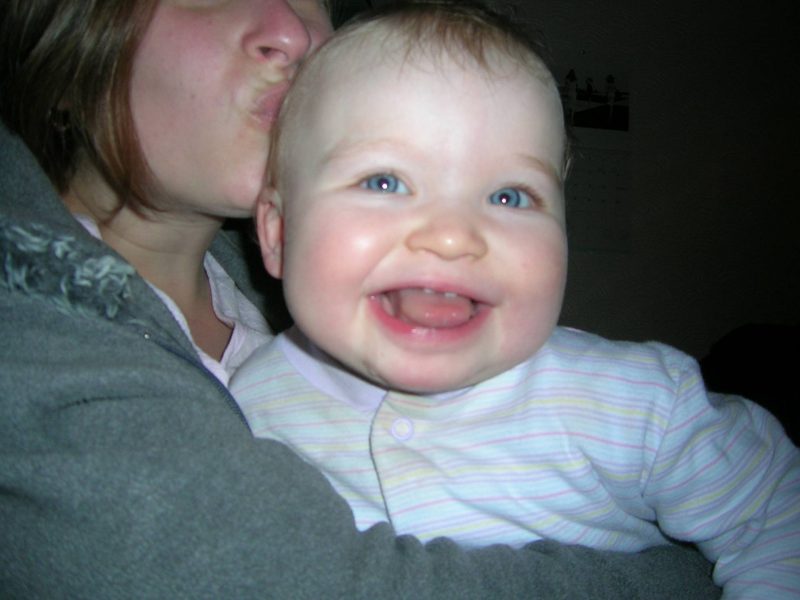
Her eyes looking up slightly, to get a smile I had to kiss her head loads!
Finally we went to the hospital, when she was aged 13 months. We had a private room. She was scheduled to have an MRI under general anaesthetic, an EEG, an eye test and be assessed by the neurologist. They kept asking me if she’d had seizures, she hadn’t, but when she was going off to sleep she would twitch like you do when you’re dropping off and jolt awake, but she stayed asleep, then once she was in a deep sleep it passed. My husband and I had started smoking again (I’d quit before she was born and He’d quit after but we both were so stressed it had crept in again). Her feet had started to point down. I was worried about her having the general anaesthetic, she didn’t like the gas mask and cried herself to sleep, it was awful. But I was actually bizarrely pleased she was happily asleep and I didn’t have to worry about her for a bit. We had the EEG. I’d mentioned about the constipation and she got prescribed a laxative – in hindsight I wouldn’t have waited for that, I should have got it from the GP and insisted I have it, but it was so hard to focus on a single thing when we were so hung up on getting this huge answer to our concerns. It was great being heard by the doctors and doing something about it. After the MRI, I mostly wanted the eye test, because I felt that if she needed glasses, this was something that could help her immediately. I had phoned up Boots to get one, but once I’d found out that children can get their eyes tested for free I think I’d been seen by the orthoptist and had the hospital appointment, so I waited. I think it was the third day we’d been in hospital, and I’d told my husband to go back to work, it was only the eye test and we weren’t going to get the other results back that day. I was on my own. The children’s eye department was in another building to the children’s hospital, I headed over there with my notes. I think a student nurse went over with me, Amy needed to have some drops put in her eyes to widen the pupil so they could check her eyes, and once in they needed time to work, so the student nurse left me to it. I saw a more junior doctor, explained my concerns and he had a look. He was checking a long time. He went to get his senior doctor. He came and looked and they discussed amongst themselves. He then got very excited, talking about a ‘cherry red macula,’ how rare it was, and made sure his junior could see it too. Amy was asleep, so she was co-operative and I let them. He explained, still very excited that they could diagnose her! Amazing, I thought, they’ve found a tumour that they can see is causing her problems and once they remove it, boom, she’s better. No. He got a text book out, and showed me what it meant. The redness in the macula part of the eye was caused by a build up of toxins that her body couldn’t remove, ever and was causing her problems with vision. She couldn’t focus because of this blur and obscurity over the middle of her eyes. She would seemingly look up a lot, when really she was looking out of the bottom part of her eye using peripheral vision. She would go blind eventually as the toxins built up. This phenomenon is only found in a certain group of metabolic conditions, which he showed me there and then, and told me in essence, there was no cure, and she wouldn’t be able to break down these toxins, causing more and more brain damage, and eventually, death. All in that excited voice. He probably realised at one point, but he said, ‘You’re a health professional, you know something’s wrong and what we’re trying to find.’ I may have been a health professional but I was there in the capacity of being a mother, plus I’d never heard of such things in my professional career, as a nurse or a midwife. I know there’s lots of horrible conditions and syndromes, but it’s not my area of expertise. To say I was devastated was an understatement. I went back into the waiting room and I think I cried. I remember the nice student nurse coming back for me and taking me back to the ward, where I gave the ward sister the notes and burst into tears (again?). I needed to talk to someone, she said she’d get the consultant to come and talk to me. I didn’t know what to do. I left her in the nurse’s care and went out for a cigarette, feeling numb. I sat on a bench next to another mum who I think I‘d seen on the ward, she gave me a light and I briefly told her what had happened. She could see I was in bits. My best friend was living in London still, we’d done our nurse training together and she was working in London, she said she would be there as soon as she could. I knew I needed and wanted someone there for what the doctor was going to tell me. I phoned my husband and told him to come up as soon as he could but that I didn’t want to tell him why on the phone. He knew, deep down.
The neurology registrar came to see me. I can’t remember whether it was a man or a woman, but they told me my beautiful daughter had one of the more severe group of conditions, she would gradually decline and would be unlikely to live past the age of 5. It was caused (in basic terms) by her missing an enzyme that breaks down lipids in cells, so these lipids build up as toxins and cause irreversible brain damage, and then death. My world caved in, and worse, how could I ever tell anyone such devastating news, the worst ever news? My parents, my in-laws, my HUSBAND! I would have to devastate them all, one by one. When my husband came, I put on a brave face and told him in my own words. The consultant neurologist came back with the other doctor again and went through it again to answer any questions she might have. Amy had had blood tests done whilst she was under for the MRI and these would be tested for genetic conditions, and they could now really narrow it down. Great. I think the eye doctor got a telling off, he shouldn’t have said anything, and certainly not how he did and to me alone. I hope he did anyway. I know the neurology team and the ward sister were cross about it, I heard from my husband. My husband still hates the neurology doctor, not because of how he was, he was always friendly and helpful, but to him, that doctor was the one who broke his heart that day.
We stayed with my friend that night, and I remember we just held each other that night and took turns crying. I told her that night that I’d always had a feeling that Amy was a gift I couldn’t keep. The next day I phoned and told my mum, who was living in France still. She is my rock and has always stayed strong for me. I could hardly get the words out. My husband told his parents, and we asked them to tell people, as we couldn’t face going over it again and again. Each time I met new people, or people who didn’t know it was awful retelling it.
A couple of weeks later we went back to London, now under the metabolic team, where we had a consultant and a specialist nurse, and the genetic blood test confirmed that it was Tay-Sachs disease. My mum and my friend had been googling and had come to this conclusion already. My husband and I had blood tests which confirmed we were both carriers of the disease. It’s really rare that two people meet who are carriers, we were told roughly 1:500,000 births are affected I think, or even less. The National Human Genome Research Institute has this to say about Tay-Sachs carrier status:
“While anyone can be a carrier of Tay-Sachs, the incidence of the disease is significantly higher among people of eastern European (Ashkenazi) Jewish descent. Approximately one in every 27 Jews in the United States is a carrier of the Tay-Sachs disease gene. Non-Jewish French Canadians living near the St. Lawrence River and in the Cajun community of Louisiana also have a higher incidence of Tay-Sachs. For the general population, about one in 250 people are carriers.”
I am from eastern European Jewish stock but I had no idea about this, my husband is of English/Irish descent. I was so shocked I had never heard of it, and I made my local trust ask pregnant women if they were Jewish, and if they were if they wanted testing! You never know what you carry though, and there are so many diseases out there that you can’t know about or test for them all – I’m a case in point. Through our journey with Amy, we met so many families where they had no diagnosis at all and never would, at least we knew.
Why didn’t I google more? I don’t know. I think I was frightened of what I might find. I remember talking on the phone with my best friend whilst we were waiting for the tests and saying my worst fears – that because she was seemingly going backward in her development, that there was only one way to go – get worse and worse and die. She made lots of reassurances, but I didn’t know at that time that this was pretty much the truth.
So how did it feel getting such a diagnosis? Gutting and devastating obviously, but also somewhat a relief – I hadn’t damaged her while I was pregnant, that time I accidentally bumped her head when she was a baby, or that Paracetamol I took whilst breastfeeding, why hadn’t I got help or insisted more earlier? None of it was my fault. I couldn’t have done or tried anything, and no amount of therapy was going to make any difference. All we could do was keep her comfortable, we would get the support we needed. I could stop worrying about making her eat lumps, getting her to hold things, in a certain way I could relax about it. I wondered what I’d done to deserve this, but I knew there was nothing. I didn’t and still don’t believe in any religion, but I used to believe in Karma. This threw a spanner in the works to that theory though.
Why is it called Tay-Sachs disease? (TSD) It’s named after Warren Tay (1843-1927), a British ophthalmologist who in 1881 described a patient with a cherry-red spot on the retina of the eye, and Bernard Sachs (1858-1944), a New York neurologist whose work several years later provided the first description of the cellular changes in Tay-Sachs disease. Dr. Sachs also recognized the familial nature of the disorder, and, by observing numerous cases, he noted that most babies with Tay-Sachs disease at that time were of Eastern European Jewish origin. Today, Tay-Sachs occurs among people of all backgrounds. I hate them. I’m grateful for their work, but for some reason, the names, the name of the disease, I can’t stand it – much like my husband doesn’t like the doctor who told us, I don’t like these men – I hate the names, I hate the sound of it, the spelling, everything. So this will be the last time I mention it in this telling of my story, I may use the initials TSD, call it the disease or the genetic condition/disorder. I always avoid telling people it by name, and will only do so if asked directly, nobody has ever heard of it, even a lot of doctors (annoyingly).
That’s it for part 2, in part 3, I’ll talk about what happened next and the hiatus. Thank you for reading my story, as ever if you have any comments or questions, I’m happy to answer them. You may share this story, if it helps anyone in a similar situation, or gives someone information, I’m happy.
Thank you for reading - if you enjoyed this content, please consider buying me a coffee here or browse my Amazon wishlist I really appreciate your support and it helps to keep the site running and for my time 🙂