

This is a cry I’ve often heard from Mothers (and Fathers) both during my Midwifery career and on every parenting forum ever. I’ve also said it myself! When I had my first daughter breastfeeding was so intense and all-consuming that I badly needed a break, but she just wouldn’t take a bottle for love or money. I was eventually at breaking point and handed her to my mother-in-law for the weekend who got her to take the bottle (of course) and I was so scared of reversing it that I stopped breastfeeding at four months.
The next time around I was so worried about it that I practically mix-fed from the start, and did the same with my third. With my last child, Daniel, I breastfed exclusively for nearly five years. Basically, you have to do what’s right for you at the time. I do think with breastfeeding, support is key and if you need a break, take it. The baby will either eat or they won’t and they certainly won’t go hungry.
Having said that, there are some things you can do to help the process of a breastfed baby taking a bottle.
There are many reasons why you may consider introducing your baby to a bottle. For example, you may want to start using a bottle so that you can start feeding your baby some expressed breast milk; or, know that you will need to leave your baby when returning to work, and you want to ensure they have some milk while you’re away from them. Some families get away with never having to introduce a bottle and go straight onto cups, but others, they aren’t so lucky. A breastfed baby can be very picky once they’re used to the breast, they seem to flatly refuse all sorts of bottles and teats no matter how hard you try, but there are a few ways around this.
If you’re establishing breastfeeding, don’t try and introduce a bottle too early, otherwise, you will risk disrupting breastfeeding. Try and wait a minimum of 2 weeks, but 6 or more weeks is best. If you’re struggling to be the main source of food, ask friends and family to help in other ways, like changing, carrying, babywearing, and taking them for walks. Get them to help around the house or cook meals or shop for you.
Whatever the reason, this is how to give your baby their first bottle, top tips in the early stages of introducing your little one to a bottle, and tactics that you can use when your child resists a bottle:
How to give your baby their first bottle
The common issue for babies being introduced to a bottle is that they will need to use a different sucking action compared to when they breastfeed. Therefore, it will likely take them time to get the hang of this new feeling. If you’re feeding formula for the first time, make sure you are making up the baby bottles correctly.
To help, look to give your child their first few bottles when they are relaxed and happy as opposed to instances when they’re hungry and more likely to want to get fed by a method that they are used to. It could also be wise to offer your baby a bottle in the evening once their regular feeding has been completed — you don’t need to give them that much milk in this instance, as it will be more about getting your child used to the feel of a bottle’s teat.
Another tip is to get someone else to give your baby their first few feeds — the dad or a friend or family member — as that way your baby will not be near you and smelling your breast milk. It may also be best if the mother is out of the house while the baby is being bottle-fed, as many babies can smell their mother even from a distance. You only need to do this a handful of times until your child is used to drinking from a bottle. It’s also easy to step in and overtake, particularly if the baby is crying and you all want some sleep!
Don’t force your baby to feed from a bottle too much, and only feed them enough milk until they let you know that they’ve had enough. This needs to be a smooth transition, so your child will be more likely to rebel if they aren’t enjoying their bottle in the early stages. They may not take much milk, but even a few sips are a triumph!
What to do if your baby is resisting
If you are struggling to get your baby to make the transition from breast to bottle, there are some techniques that could help. I’ve transitioned 3 babies to combination feeding successfully using these methods, and my last baby took a bottle when necessary.

Types of Bottles and Cups Best for a Breastfeeding Baby
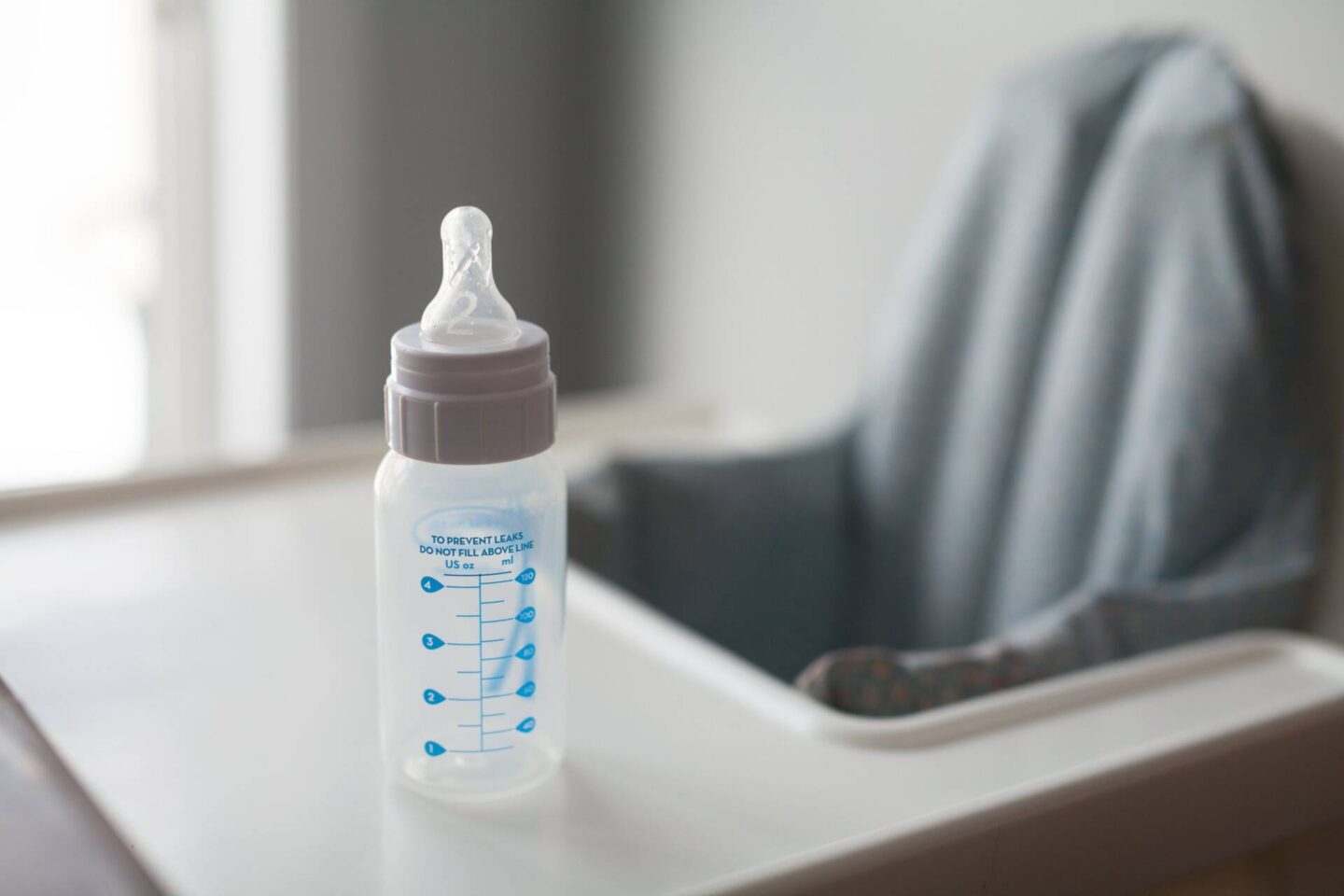
You should take the time to find a suitable product for your baby. A bottle with a teat that is similar to your child’s dummy if they have one will likely make it more appealing to your little one, for instance. Look at the shape and size of your nipple and choose a teat that’s similar – The wide neck style bottles definitely work better with breastfed babies and choose the slowest flow teat, or a variable flow one, as you want to try and replicate the letdown reflex they’re used to. Variable flow lets you start slow and then twist it around to make it faster flow. The soft, flexible silicone is best, and BPA-free.
There’s a new type of bottle available called The Teatle, which is very breastlike and they can get a deep and comfortable latch as they can on the breast. It looks different from other bottles I’ve seen. You can read more about them and pre-order here.
If you want to bypass the bottle altogether, try a transition bottle to cup. It really doesn’t matter how they get the milk in, as long as it gets in!
Positioning and other tips and tricks to get a breastfed baby drinking from a bottle
It’s not just the design of the bottle or cup that can help your baby with the transition. Your baby may start sucking from the cup or bottle’s teat if you place some breast milk on it and your child tastes it and enjoys the familiar taste.
Let your baby get used to their new bottle or cup in their own time too. Don’t be quick to take the product away from them if they begin to chew on the teat — let them do this for now as they may switch to sucking on it once they are familiar with the feeling. They may roll it around their mouth and just stare at you – this is normal at first! Try angling the teat to the roof of the mouth, cupping their face as you hold the bottle.
Inserting a clean finger into their mouth and letting them suck on it, then swapping the finger for the bottle can work well. Once they know milk comes out and it feels familiar, you’re away. Some women have success by starting breastfeeding, then switching to the bottle when the sucking action is underway. They may just get annoyed with you though.
Babies may also feel more comfortable drinking from a bottle when they are held in a different position than how you breastfeed them. Feed them from a bottle when they are in a semi-upright position in a car seat, for example, or by having them on your lap but with their back to your chest, or propped up on your knees facing you.
You can flip it the other way and make it uber-like breastfeeding, have the bottle tucked under your armpit, and keep the baby in the same position, latching them onto the bottle. Think about how your baby latches onto the breast, and mimic that.
Lastly, if the baby is over 6 months, depending on how long you’re leaving them, will they desperately need milk? If they’re really adamant they won’t take a bottle, don’t force it, give water and food and they’ll catch up on milk when you get back. If they are hungry for the milk they will take it eventually, babies won’t intentionally starve themselves.
Temperature and storage of breastmilk
Once expressed into sterile containers or bags, breastmilk can be stored in the fridge for up to five days at 4C or lower (you can buy relatively cheap fridge thermometers online); for two weeks in the freezer compartment of a fridge; for up to six months in a freezer. Breast milk that’s been cooled in the fridge can be carried in a cool bag with ice packs for up to 24 hours. If you’re freezing it, make sure you label and date it first, and put how much, because once it’s frozen it’s not so clear. It’s normal for breastmilk to separate into a clearer layer on the top, it doesn’t mean it’s spoiled.
It’s best to defrost the frozen milk slowly in the fridge before giving it to your baby. If you do need to use it straightaway you can defrost it by putting it in a jug of warm water or holding it under running warm water. Never microwave your breastmilk, as it damages the contents and can cause hot spots. Once it’s defrosted, use it straight away. Don’t re-freeze milk that has been defrosted. Any expressed milk out of the fridge or freezer should be used within 2 hours.
When introducing a bottle of expressed milk, warm it to body temperature (about 37ºC), as that’s what they’re used to.
Hopefully, with this advice, your baby will be happy to accept the bottle or cup for those feeds you need before you know it. Remember I’m always on hand for advice if you need it, or a friendly ear.

Disclosure: collaborative post

2 Comments
Great post! This is deffo a tricky subject for many. My son has never had a bottle, I tried to get him to take some expressed milk when he had a cold and snuffy nose so struggled to feed while breathing and it was successful. It was stressful as he was crying for comfort but crying because he couldn’t breath and went on a bit of a nursing strike for a few days!
July 1, 2023 at 9:57 amI’ve had four children and all were different! I don’t think there is any wrong way to do it as long as they are loved.
July 3, 2023 at 10:58 am